Showing posts with label easy guide to vitamins and minerals. Show all posts

Wednesday, October 7, 2009

Mineral Vitamin Supplements Are Essential


UltraMulti-Mineral Complex

Highly absorbable citrate forms
4 essential minerals


UltraAlbion Chelated Multi-Mineral

Ultimate health-promoting minerals
Enhanced absorption Maximized benefit


Ionic Trace Mineral Drops

Over 72 naturally occurring minerals
26 times more concentrated


The majority of mineral vitamin supplements are made from chemicals rather than natural substances. However, there is a steady growth in the demand for natural mineral vitamin supplements. This is due to the amount of debate that there is as to whether chemical mineral vitamins can be more harmful than beneficial in the long term.

The fact is that chemical mineral vitamin supplements are not as easily absorbed as normal food particles are. The mineral vitamin industry is constantly striving to create products that are more easily processed by the body and therefore more beneficial.

Every now and then the industry comes up with a new 'more bio-available' form of a vitamin or mineral. To overcome this, a large number of mineral vitamins have been developed that combine other elements with the vitamins and minerals to enable them to be more easily absorbed by the body. Iron is commonly combined to form iron gluconate which enable the mineral vitamin supplement to be more absorbable.

The amount of a nutrient in a mineral vitamin supplement needs to be far greater than it would be in a more natural form for the body to be able to absorb the amount that is required. This can obviously lead to problem where a toxic level of the particular nutrient is being consumed by the large doses of the mineral vitamin supplement that are needed. It is therefore extremely important that a person does not simply take vast quantities of all of the mineral vitamin supplements that are advertised on television and should seek advice from a health professional. It is also worth being aware of the developments in the mineral vitamin supplement industry as there are constantly new and better combinations being developed.

One method that mineral vitamin manufacturers have developed to help aid absorption is through culturing the raw materials with yeast cells. This form of mineral vitamins are known as ‘food state’ and are up to four times easier for the body to absorb the required nutrients as the yeast is completely digested.

Of course, the need for mineral vitamin supplements depends on the diet that a person has. There is no doubt that it is far more preferable for a person to obtain the nutrients that they require from their food rather than by taking mineral vitamin supplements wherever possible. During certain periods it may be necessary for a person to take mineral vitamin supplements on a temporary basis but their long term use is not recommended for a number of the supplements that are available.

Tuesday, February 24, 2009

The Sunlight Vitamin

Sunlight is composed of electromagnetic radiation of varying wavelengths, ranging from the long-wavelength infrared light to the short-wavelength ultraviolet. The ultraviolet light is further subdivided into UVA and the even shorter-wavelength UVB radiation. Although UVB causes sunburns, it is also the component that initiates Vitamin-D production in the skin. As such, scientists now believe that past sunscreen use actually promoted skin damage, while, at the same time, blocking beneficial vitamin-D production. (Sunscreen reduces the skin’s ability to produce vitamin D by at least 95%.)

Click To Enlarge
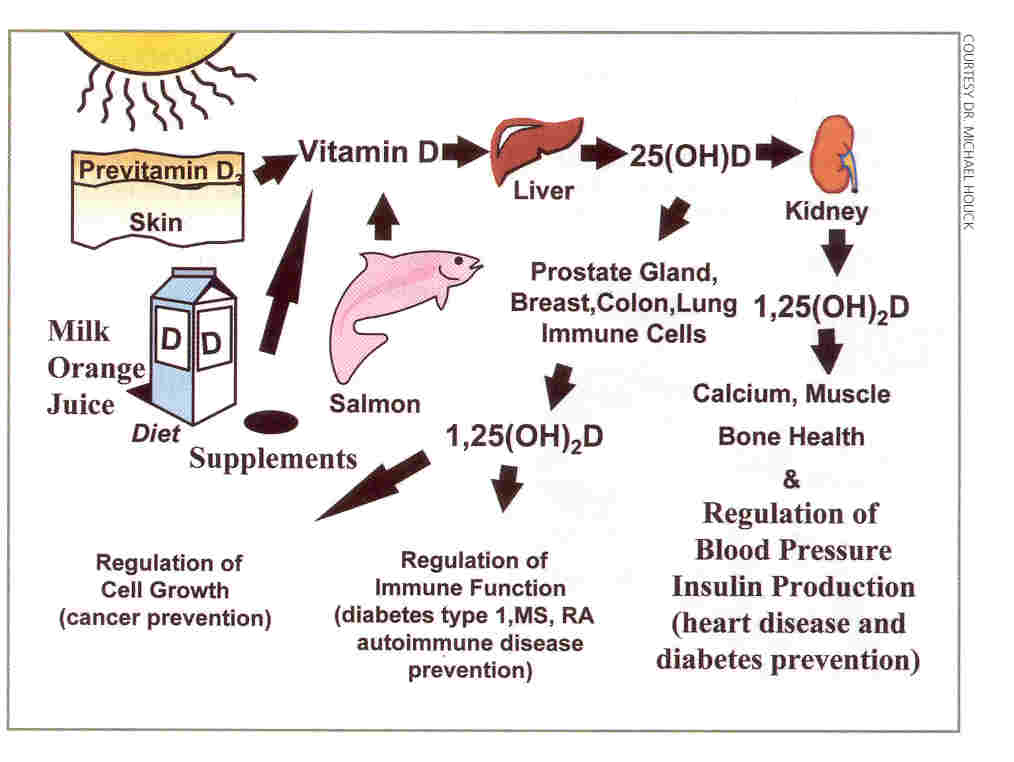
The process by which vitamin D is produced and exerts its biological effects is complicated, involving several vitamin-D-related molecules. Basically, UVB light triggers a modification of a cholesterol-related molecule located in the membrane of skin cells. The vitamin D that is created is then ejected from the membrane into our circulation system, where it travels to the liver. In this organ, it is transformed into 25-hydroxyvitamin D, the derivative that doctors use to assess overall vitamin-D status.

The kidney, as well as some other tissues, further converts this precursor into 1,25-hydroxyvitamin D, the most physiological active vitamin-D metabolite, which is also called calcitrol. Traditionally, calcitrol is understood as a hormone that, together with parathyroid hormone, regulates blood calcium levels and, in turn, bone density. In this role, calcitrol targets the intestine, where it promotes calcium absorption; and bone, where it catalyzes calcium release to help restore depleted blood calcium levels.

However, recent studies indicate that viewing calcitrol just in this role is quite limited. In fact, the hormone exerts a plethora of biological effects on diverse tissues, implying that this sunlight-generated hormone sustains health throughout the body.

Although much remains to be understood, basically, circulating calcitrol enters cells and complexes with the genes in the cell nucleus. This affects DNA expression and, in turn, overall cell functioning and growth. Because calcitrol maintains normal cell proliferation, it inhibits cancerous growth. In addition, calcitrol influences immune-cell activity, helping to explain vitamin D’s seemingly beneficial role in infectious disease and immune-related disorders, such as multiple sclerosis, rheumatoid arthritis, and diabetes.

Given these considerations, the implications of preventing vitamin-D deficiency, either through sunlight or diet, are now more profound than ever.