The majority of people do not have enough natural vitamin sources in their diet, they therefore suffer from a deficiency of one or more vitamins. Obviously, it is possible to buy vitamin supplements to help overcome any deficiencies but for the majority of people it should be possible for them to obtain the majority of their (RDA)recommended daily allowance of vitamins from Natural Vitamin Food Sources. The key to gaining the correct amount of vitamins from a Natural Vitamin Food Source is to eat a healthy and balanced diet. 
• Natural vitamin B1 sources- brewer’s yeast, whole grains, blackstrap molasses, brown rice, organ meats, egg yolk
• Natural vitamin B2 sources- brewer’s yeast, whole grains, legumes, nuts, organ meats, blackstrap molasses
• Natural vitamin B3 sources- lean meats, poultry & fish, brewer’s yeast, peanuts, milk, rice bran, potatoes
• Natural vitamin B4 sources- egg yolks, organ meats, brewer’s yeast, wheat germ, soybeans, fish, legumes
• Natural vitamin B5 sources- organ meats, egg yolks, legumes, whole grains, wheat germ, salmon, brewer’s yeast
• Natural vitamin B6 sources- meats, whole grains, organ meats brewer’s yeast, blackstrap molasses, wheat germ
• Natural vitamin B7 sources- egg yolks, liver, unpolished rice, brewer’s yeast, sardines, legumes, whole grains
• Natural vitamin B8 sources- who1e grains, citrus fruits, molasses, meat, milk, nuts, vegetables, brewer’s yeast
• Natural vitamin B9 sources- dark-green leafy vegetables, organ meats, root vegetables, oysters, salmon, milk
• Natural vitamin B12 sources- organ meats, fish, pork, eggs, cheese, milk, lamb, bananas, kelp, peanuts
• Natural vitamin B13 sources- root vegetables, liquid whey
• Natural vitamin B15 sources- brewer’s yeast, rare steaks, brown rice, sunflower, pumpkin & sesame seeds
• Natural vitamin B17 sources- whole kernels of apricots, apples, cherries, peaches, plums
• Natural vitamin C sources- citrus, cabbage family, chilli peppers, berries, melons, asparagus, rose hips
Friday, May 15, 2009
Natural Vitamin Food Source

Tuesday, February 24, 2009
The Sunlight Vitamin
Sunlight is composed of electromagnetic radiation of varying wavelengths, ranging from the long-wavelength infrared light to the short-wavelength ultraviolet. The ultraviolet light is further subdivided into UVA and the even shorter-wavelength UVB radiation. Although UVB causes sunburns, it is also the component that initiates Vitamin-D production in the skin. As such, scientists now believe that past sunscreen use actually promoted skin damage, while, at the same time, blocking beneficial vitamin-D production. (Sunscreen reduces the skin’s ability to produce vitamin D by at least 95%.)
Click To Enlarge
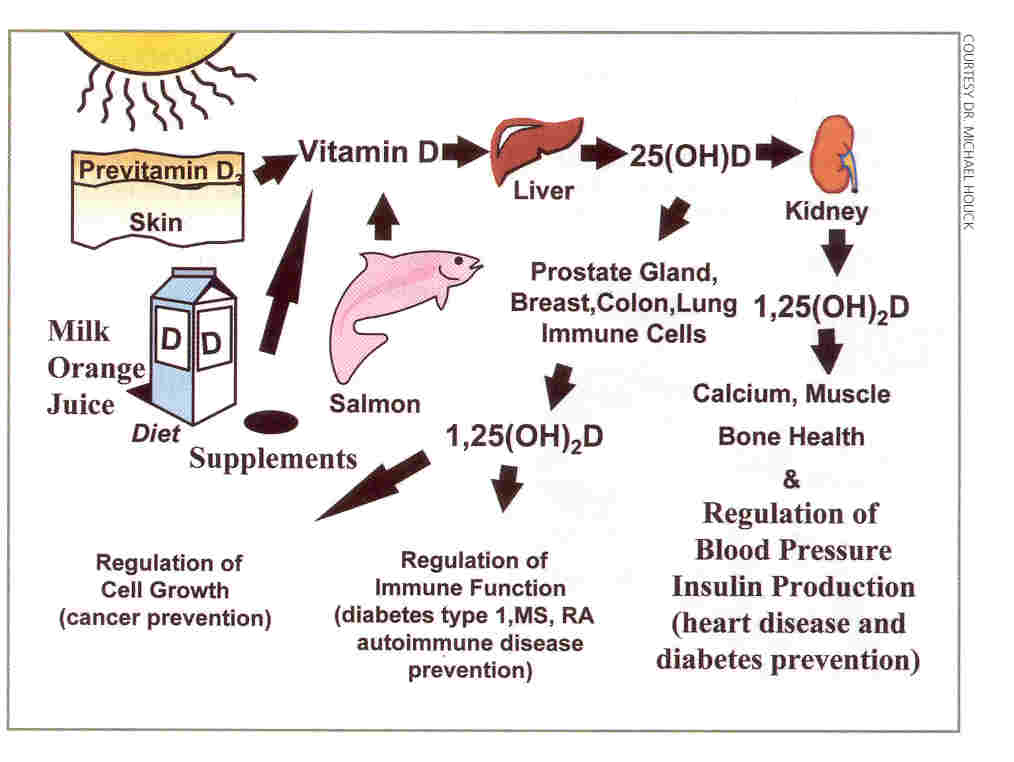
The process by which vitamin D is produced and exerts its biological effects is complicated, involving several vitamin-D-related molecules. Basically, UVB light triggers a modification of a cholesterol-related molecule located in the membrane of skin cells. The vitamin D that is created is then ejected from the membrane into our circulation system, where it travels to the liver. In this organ, it is transformed into 25-hydroxyvitamin D, the derivative that doctors use to assess overall vitamin-D status.
The kidney, as well as some other tissues, further converts this precursor into 1,25-hydroxyvitamin D, the most physiological active vitamin-D metabolite, which is also called calcitrol. Traditionally, calcitrol is understood as a hormone that, together with parathyroid hormone, regulates blood calcium levels and, in turn, bone density. In this role, calcitrol targets the intestine, where it promotes calcium absorption; and bone, where it catalyzes calcium release to help restore depleted blood calcium levels.
However, recent studies indicate that viewing calcitrol just in this role is quite limited. In fact, the hormone exerts a plethora of biological effects on diverse tissues, implying that this sunlight-generated hormone sustains health throughout the body.
Although much remains to be understood, basically, circulating calcitrol enters cells and complexes with the genes in the cell nucleus. This affects DNA expression and, in turn, overall cell functioning and growth. Because calcitrol maintains normal cell proliferation, it inhibits cancerous growth. In addition, calcitrol influences immune-cell activity, helping to explain vitamin D’s seemingly beneficial role in infectious disease and immune-related disorders, such as multiple sclerosis, rheumatoid arthritis, and diabetes.
Given these considerations, the implications of preventing vitamin-D deficiency, either through sunlight or diet, are now more profound than ever.